
Benefits from the Establishment of the Park

Our heartfelt condolences to everyone affected by the sudden landslide in Gofa, Southern Ethiopia, and our thoughts are with those who have lost their lives and their loved ones. We commend the ongoing rescue efforts to support families in grief and to re-establish society on a familiar and emotionally stable foundation.
Ethiopia's Grande Nature History
With Water Harbouring Functions
Background: Due to these damaging effects of the foreign implanted tree and its shortcomings, the water-preserving capacity of this Eucalyptus plantation cannot counterbalance the regular seasonal, uneven distribution of rain. The result is, regrettably, massive water loss and uncontrollable torrential flooding, inundating the down-slope areas, in this case, the northern district of Addis Ababa. In August 1994, it posed a fatal danger due to sudden, overwhelming flooding. Hence, the importance of the guardian and a deeply rooted network of roots and stems emerges, revealing its crucial role in a complex picture of water distribution in the mountain massif. This harbouring of water masses is Nature's original heritage purpose, not only for the plant's survival but also for wildlife and humankind's survival. In the past, the endemic vegetation in Ethiopia's highlands consisted of a primaeval forest with an intricate network of stems and a deeply anchored root system, functioning as countless efficient reinforcements of the otherwise exposed and fragile soil. Here, a natural legacy reveals its precious, ancient presence from a time far before the rise of any known animal species, now preserved only as petrified strata in deep geological sedimentary rocks.
Historical Background of Entoto Natural Park
Careful Considerations and Opportunities (1995)
Once established, the Entoto Natural Park will serve as a vital demonstration of how the mountain ridge around Addis Ababa was once covered with the Indigenous Juniperus procera and how this unique type of native Ethiopian Nature is being restored. Furthermore, this retrospective consideration provides a necessary scientific background for studies by confirming the importance of international scientific research on the Environment. Hence, this critical worldwide commitment is elucidated and enriched by restoring Ethiopia's native woodland, thereby revealing the natural background for replacing the foreign Eucalyptus forest. Thus, a historical landscape is restored by building up the ground with plants that embody Ethiopian identity and by stabilizing what had been lost over centuries of erosion. Gradually, the native forest will mature into a green lung, improving the air for the citizens of Addis Ababa.
The Importance of Indigenous Trees
 |
| The Environment, Culture and Prosperity |
Ethiopia's Prehistory of Natural Wealth
The native Ethiopian vegetation served as a highly effective physical barrier, blocking the country's water masses from rushing down its slopes toward Egypt. From Nature's ground, a picture of the soil's water-absorbing structure and root configurations emerges. Thus, along with the strength of the intricate network of endemic vegetation and the native undergrowth, the seasonal deluges had sophisticated water-holding capacity in Ethiopia's thick soil layers.
Therefore, after the downpours, with their root reinforcement, the deep soil layers and ground moraine delivered purified water into the terrain's deep aquifers as groundwater. Hence, this original vegetation functioned as countless efficient water collectors, with an intricate network of stems and deeply anchored roots, further stabilizing and providing tremendous strength against erosion.
Within this hidden enigma at the beginning of life lies the precious synergy between the ground and plants, enabling them to build tremendous strength within the ground's structure. This ground, built by Nature in the far remote past, was the foundation for the evolutionary cradle of the origin of more complex organisms. Therefore, all higher living organisms today have their existence thanks to the predating development of plants with their roots and the surrounding earth. Hence, the organisms became intricately dependent on each other, with the plants and their roots creating the actual soil stabilizers and purifiers for the ground and aquifers. Therefore, in historical times, Ethiopia's considerable rainfall resources were less contentious, mainly because the abundant natural vegetation in its highlands still enabled the deluges to remain stable within the depth of this mountainous landscape.
A Wonderful Memory from Ethiopia
Attracts Modern Science and Art
With Entoto's sculptural brooks and natural cliff pools, this historic mountain remains a precious memory, a heritage of sincere affection and natural wealth. Thus, it's a venerated time when the mountain massif and its canyons can carry significantly higher quantities and higher-quality water. Therefore, with glowing passion and warmth among the residents of Entoto, the joy of memories still lingers when, at a reasonable time after the rainy season, the water level in the brooks and natural cliff pools of the high plateau still stood one metre higher. With the profound history of Entoto's rock-sheltered streams and enchanting nature rock baths, this beautiful memory remains vivid among the inhabitants of this legendary mountain today.
The History of the Environment
.jpg)
The Prehistoric Legacy of Water and Plants
The prosperity of civilizations across different cultures and parts of the World indicates an evident connection between in-depth knowledge of biology and a culture's potential for development. Without a doubt, this rule is considered healthy in this context and in other sciences as well. Still, it is particularly evident in biology, as it is so closely related to human health and well-being. However, the insidious hierarchical governing terror of the past caused severe scares among many nations, inflicting humiliation in severe starvation and fearful aversions, thus damaging the population's most critical needs for safety.
Ethiopia's Indigenous Vegetation
A Heritage with Tremendous Potential
The native vegetation was, in the past, a natural shield that prevented the precious water from being wasted by violent torrents. This seasonal water flow over the Ethiopian Highlands then historically, and even more prehistorically, infiltrated the deluges into soil permeability and vertically delivered this mass of purified water to be stored as natural groundwater within ancient aquifers. Hence, the fabric of these original vegetation's roots and soil functioned as countless efficient conduits for deluges, directing them into Ethiopia's deep soil layers and the country's mountain massifs' aquifers, thus preventing groundwater shortages during long periods of drought.
A Regrowth of Native Vegetation
When the dedicated guardianship of the endemic restorative work results in a new Indigenous forest that has grown for several years, and action has been taken to halt erosion, the risk of flooding will be eliminated through the reinforcement of Indigenous roots and soil, with a water infiltration capacity well above today's levels. A balance is vital between the constraints of the landscape and man's land use, where spontaneously introduced animals will enrich the present wildlife. It is urgent to preserve the remaining wild forests in Ethiopia. Creating a scientific front to implement Entoto Natural Park's sustainability will align with Agenda 21 (a document signed at the Rio Conference upon the need to conserve natural resources on earth).
 |
| The Indigenous Podocarpus falcatus |
The Highland's Clean Air & Clean Water
Sanctuaries and Museums, and StudiesThe experience of Ethiopian original, naturally fertile beauty near Addis Ababa, with fashionable facilities and historically significant Sanctuaries and museums, will attract many people every season. Schoolchildren will be actively using the Park for environmental education purposes (or to find a peaceful spot to do homework. Restaurants and amenities at Entoto Kidane Mehret (1), Entoto Maryam (43), Entoto Park (Z)
A Source of Health for the Capital
A Natural Park for Weekends and Tourism
Tourists (mainly international) will enjoy views of Addis, a visit to a restaurant on a hot afternoon, and the calm of the juniper forest. Regular citizens of the Capital will mainly come on weekends. Still, visiting parks in Addis Ababa is a cultural habit, so visitors are expected to be high on Saturdays and Sundays. (Håkan Blanck and Pia Englund, Entoto Natural Park 1995). Accommodation and Food Services
A Natural Park for Weekends and Tourism
Tourists (mainly international) will enjoy views of Addis, a visit to a restaurant on a hot afternoon, and the calm of the juniper forest. Regular citizens of the Capital will mainly come on weekends. Still, visiting parks in Addis Ababa is a cultural habit, so visitors are expected to be high on Saturdays and Sundays. (Håkan Blanck and Pia Englund, Entoto Natural Park 1995). Accommodation and Food Services
The Healing Capacity of Indigenous Forests
A Historical Legacy Of Environmental ImportanceThe natural health and fertile beauty of this indigenous Juniper forest illuminate with precision the healing ability of a native forest and the severe Nature and habitat destruction that occurred with the introduction of the Eucalyptus tree. Due to these shortcomings in the Eucalyptus plantation's water-retention capacity, it cannot counterbalance the uneven distribution of rainfall. This eucalyptus poisoning of the ground creates a devastating water-rejecting fabric, yet hazardously brittle and prone to the sudden collapse of the upper soil layer, all too often followed by disasters and torrential flooding in the down-slope areas, in this case, a seasonal risk for the northern district of Addis Ababa.
The Danger Of Foreign Toxicity Follows Shortsightedness
Knowledge of natural aquifers and their synergies with water technologies is a highly valued historical legacy, dating back to a time long forgotten in prehistory. In their context, they are a well-known concept that helps to understand that a mighty mountain massif that receives abundant and regular precipitation with chilly temperatures also provides the conditions for harbouring this water, provided the landscape is not depleted of its endemic vegetation, which downloads and directs the water to the landscape and its aquifers. Hence, scientifically based investigations and practical actions grounded in experience to mitigate erosion are crucial; otherwise, the erosive forces from torrential deluges pose an overwhelming risk of sudden flooding. Due to the damaging impact of foreign intruder trees on the county's original Nature, this eucalyptus tree's toxicity in Ethiopia's Nature underscores the importance of careful research into the toxicity of dangerous, incompatible substances, which can cause soil degradation, such as erosion, dust bowl or devastating landslides or mercilessly fatal lahars. Here, knowledge of the natural sciences is considered essential before any aggressive species is introduced into a potentially vulnerable habitat.
Water to the Capital
Aquifers and Technology
 |
The Valuable Knowledge Of Antiquity
Caution: The image on the left, of antiquity (the Ancient Roman cistern Piscina Mirabilis), highlights the treacherous misconception of stability and safety in today's building practices. This doubt stems from modern dams and their catastrophes of the last century. Indeed, constructing artificial dams to meet the water needs of a larger population has, in modern times, proven hazardous to nearby settlements. In ancient times, a technology still prevailed to prevent the fatal collapse of artificial dams by creating mountain chambers instead. Hence, these ancient hewn-cliff chambers defy and challenge the hazardous shortcuts in the latest century of dam construction.
Ancient Underground Reservoirs
Historically developed technical and geological-based methods for managing and conserving large volumes of water are often technically complex and aesthetically exquisite. The historical constructions for securely harbouring water are shown in the picture to the left. The methods of water technology vary significantly across cultures and continents. Still, in the history of civilization, they are the basis of ancient civilizations' most decisive and original technological achievements and of their ability to progress in today's high-tech development.
A Mountain Massif's Water-Harbouring Properties
The Hidden Ties of the Highlands and the Plants
To explain the complex and difficult-to-explain phenomena in Nature, and what seems too complicated to describe in standard terms, can sometimes be given a simple parable opportunity. In short, a few stones do not hinder a flowing torrent but are well hindered by a firmly anchored and reinforced stone construction. Consequently, the few randomly placed rocks are lost in futile hardships, with crouching labourers by sweat and thirst in toil's despair and poverty. In contrast, the opposite is usually true for the deeply anchored unit and the amount of valuable water dammed at hand for use during a drought. Of course, the natural forest is home to many complex biological phenomena, with countless plants and organisms in symbiotic relationships, and a highly ancient evolutionary origin as water protectors for the Environment.
Humankind's High-Tech With Nature's Foundation
Thus, the mountains' native highland vegetation and primaeval forests, with their extensive network of organically self-repairing armouring effects, drastically enhance protection against landslides and lahars. Hence, a precious evolutionary synergy arises from the endemic vegetation's capacity to subdue the torrential force of water on the mountain's slopes, carefully buffering these deluges while gradually feeding them into the deep, essential, and natural underground aquifers. Therefore, this phenomenon, which lies in the higher terrain of the native forests' water-harbouring effect, is revealed in the image below, with its clear aquifers within the vast embrace of a stabilizing massif. From this, an obvious connection emerges between the armouring and water-protection effects of the Indigenous forests in the mountain massif and the need for high security in state-of-the-art dam constructions.
 |
| This picture shows the importance of storing the high-lying mountain water instead of rejecting it in rapid flows.This stored water in the mountain massif is crucial in the following years. It thus provides the lower-lying villages with a stable the flow of purified water during the year. Water and Land Restoration |
The Indigenous Vegetation's Health
The Source of Water and Wealth
The native forest and scrub are essential for creating groundwater in the natural mountain reservoirs of underground aquifers. This original ground exists in natural areas with complete undergrowth and indigenous biological microstructure, unique to places such as established national parks, which have a superior ability to withstand erosion. This interconnectedness between trees, the ground, and indigenous vegetation is crucial for distributing rainwater and preventing environmental decay. Naturally, with high importance, work should prioritize endemic forests on mountain massifs.
Endemic Trees: the Defence Against Erosion
These careful considerations of native Nature are reflected in a complex and beautiful picture of lifeforms, where they optimize the code through aeons-old evolutionary symbiotic networks. Thus, through this evolution of antiquity, the natural forest developed immense strength in creating groundwater and an extreme capacity to withstand erosion. Furthermore, it's essential to understand the precarious synergy between the native plants' highly advanced biology and the ground they have shaped over aeons.
Nature's Mighty Rain Receiving Reservoir
Within the inviting beauty of the natural landscape lies a complex biology in the primaeval forest, which hides critical scientific insights through its tremendous capacity to generate groundwater and its natural way of enriching clouds to produce precipitation. This evolutionary heritage underscores the indigenous forest's optimized role as a water guardian, a testament to its overwhelming strength. The indigenous forest plays a crucial role in saturating the aquifers, with its potent water-holding effect within the actual depth of the mountain massif. Hence, the body naturally harboured water, retained in the mountains' native highland vegetation, primaeval forests, and aquifers, which can be considered and scientifically analyzed with considerable help from the methods used for highly complex dam and reservoir constructions.
Water Salvation With Native Ethiopian Trees
Erosion: Because there is no ground cover beneath the foreign tactical poisoning from Eucalyptus trees, the only thing holding the soil is the sporadically and sparsely occurring web of roots in these alien trees. Therefore, the soil-holding capacity of Eucalyptus is very moderate compared with the indigenous trees initially covering the slopes of Entoto. Hence, once the new Indigenous forest has grown for some years and action has been taken to halt erosion, the risk of flooding will be eliminated, as the soil will be healthy and robust, with a water infiltration capacity well above today's levels. A balance, and even a symbiosis, is intended between Nature's unique demands on the indigenous species and man's land use. Hence, this positive synergy creates a foundation for the population's health and stimulates the positive side effect of a restored landscape where the original Nature spontaneously introduces new animals that will enrich the present wildlife.
The Torrential Rains and Erosion
 |
| The Torrential Rains and Erosion |
The Australian Tree's Hostility in Ethiopia
A chemical defence mechanism in the leaves and roots of eucalyptus trees aggressively interrupts the growth of other trees and herbs. This toxic chemical component poisons Ethiopia's native vegetation, leading to a monoculture of Eucalyptus as the only tree species and, eventually, to the loss of ground cover, causing devastating erosion.
A chemical defence mechanism in the leaves and roots of eucalyptus trees aggressively interrupts the growth of other trees and herbs. This toxic chemical component poisons Ethiopia's native vegetation, leading to a monoculture of Eucalyptus as the only tree species and, eventually, to the loss of ground cover, causing devastating erosion.
A Foreign Toxin with Soil Milling Properties
This chemical component causes severe loss of the grounds' natural armour, followed by erosion - easily observed in the water running through the developing countries during the rainy seasons. For every rain period, the layer of fertile soil gets thinner. If nothing is done, the erosion will be irreversible for the mountainous terrain.
 |
| The Eucalyptus Problem |
A Toxicity Causing Desertification and Famine
Ethiopia's landscapes' endemic trees and native undergrowth ground cover constitute the armour of the deep and vast network of endemic plants, which often do not survive the perpetual onslaught of this foreign and toxic substance, which causes an unavoidable impoverishment of the landscape. Hence, the following lack of native vegetation causes uncontrollable erosion in forcefully ground chiselling flashfloods, resulting in the landscape losing its precious nourishment.
A Foreign Toxin Threatening the Population
This chemical threat thereby gravely impoverishes farmers' daily lives and, regrettably, even the conditions for their survival. The following impact of the severe loss of water resources by torrential flashflood rejection of valuable deluges by short-lived, sudden and violent, bursting water masses is also threatening the country's long-term harvest, thus posing a real threat to the population's health and life quality, therefore affecting the long-term survival of the country's inhabitants and the country's unique habitats.
The Humankind and Nature in Harmony
Sustainable Development and Health
The restoration of Ethiopia's native vegetation and the transformation of Eucalyptus plantations by liberation from foreign intruders are crucial. On Entoto's mountain massif, this critical restoration of Nature's stability and resilience remains essential to the country's natural foundation and, in turn, to the well-being of its citizens. Biodiversity, through the planting of indigenous vegetation, serves the population economically and biologically by improving the climate and increasing access to clean water. Restoring Entoto Natural Park's original Nature will allow the Capital to significantly increase access to drinking water. Therefore, natural forests are crucial, as they are complex biological systems with countless plants and organisms in symbiotic relationships, and have a highly ancient evolutionary origin as water protectors for the Environment.
The Inheritance of Plants Depends on the Stimulus
From the Landscapes' Climate within a Country
 |
| The mistake of using the seed from a tree with genetic originating from a moist and shady gorge as seedlings on a dry southern slope undermines the trees' ability to survive and other organisms. However, this endures an intricate symbiotic phenomenon. Trees, Shrubs, Flowers and Herbs |
Trees' Origin from the Country's Terrain and Climate
Thus, distant locations within a country's topography and geography, yet within the same country's borders, have developed flora and fauna that have undergone an extremely long evolutionary process to best adapt to the unique conditions of their geological surroundings. Therefore, depending on the region's unique climate, the area's specific habitat within a country has shaped the native indigenous organisms, whose distinctive properties arise from close harmony with the soil types that have developed over aeons of Nature's obvious composting process, including mineral-sediment mixtures. Hence, this country's topographically isolated location imparts distinct genetic properties in organisms due to local, unique climate factors across its landscape.
Landscapes Give the Origin to Plants and People
Therefore, depending on whether it grows on a mountainside or within a shady gorge, the endemic tree has shaped the specificity of its genetic heritage, reflecting the landscape's unique climate. Thus, the trees' evolutionary connection to a country's landscape creates a precious legacy for their seeds, which inherit well-adapted genetic characteristics in their pedigree related to the location's climate-technical uniqueness. This background of diversity in stimulus activation also includes humans, whose health and ability to work are highly dependent on the uniqueness of their natural heritage, and whose well-being requires a corresponding stimulus from their culture.Nature's Production Of Clean Water
The vertical connection in the study below demonstrates how a ground depleted of its evolutionary symbiotic vegetation proves difficult to provide water-absorbing permeability. This cultivated, tilled, mechanically disturbed soil (9) - (B) - such as that affected by ploughing for cultivation - struggles to absorb and infiltrate precipitation. As a result, a significant amount of water is lost to runoff (RO) picture (9) at its right side (B), which is evident by the murky collected flows down into collection vessels with its arrow sign (RW). The primary reason for this modern issue of reduced water infiltration is that the cultivated soil's structure and organisms lack the evolutionary traits necessary for an evolutionary relation with an artificial tillage field (8) - (B) - (9) - (B), and therefore lack the appropriate particle configuration to effectively absorb or deeply infiltrate water. Although this image study does not include laboratory evaluations of water absorption in the original vegetation of a native forest with undergrowth, it indicates that the natural Environment depicted on the far left of the image (8) shows enhanced water infiltration values downwards the plants' roots and further towards the groundwater at the bottom of the image (8) - FW1.
 |
| The Problem With Foreign and Incompatible Trees and their Devastating Effect on the Water. The Torrential Rains and Erosion |
The No-till ground on the left side in images (8) - (9) points (A) shows the familiar surroundings of the seasonal field at rest. Compared to the tillage field (B), the No-till ground (A) provides significantly better resistance to decay and improves water distribution to groundwater reservoirs. Pictures (9) show this resistance to the decay phenomenon (A) by increased resistance to soil loss and its ability to store water. This filtered water can transform into purified water within the hidden cliff chambers (aquifers). This filtered water in the study (8) - FW1 accumulates during the rainy season, seeping continuously into the deeper underground. Therefore, cities below the mountain massif depend significantly on the Highland's native vegetation, including agriculture, through these high-altitude properties that geologically store mountain water, which is conveniently extracted by traditional or advanced methods during drought seasons the following year. Videos: Soil Erosion Demo
Picture (9) clearly shows how the tillage field example (B) to the right in the photo means about twice the amount lost in the runoff in comparison with the No-till soil on the left (A). Also, the left No-till soil (A) with its water tray displays considerably less erosive sediment in the water tray in comparison to the tillage field on the right in images (9) - (10) - (B). The vertical connection of the (FW) arrows 1 and 2 in embodiment (8) appears very clearly as an effect in the study of example (9). Models (8) and (9) confirm an apparent relationship along the waterways of FW1 and FW2, shown in the lower part of Figure (8). A practical solution to its problems with water loss and erosion on sloping land is well established; here is a link to an exciting introduction.
Wikipedia: Regenerative Agriculture
Nature Restoration: A Foundation for Science
Using Underground Modern Technology
As an intervention that artificially rebuilds millions of years of accumulated ground stability in concert with soil layers and the evolution of organisms, it often seems impossible to recreate a lost ancient ground within generations. However, some modern technologies, such as gabion baskets and mountain anchors, can frequently replace lost ancient stabilising sediments and the crucial reinforcing strength of lost ancient tree roots. Gabion technology and rock anchors are current techniques that can enhance safety for settlements by providing new stable ground for plant growth on slopes. Therefore, the use of technology, such as gabions with cliff anchors, offers a safer means of preventing dangerous landslides while also providing an important base for the growth of endemic saplings.
 |
| Landslides and Erosion |
CAUTION: Landslides and Erosion
Thus, from Nature's ancient past, the mechanical compression of moraine and clay towards the mountainside provided Nature with the required strength for an evolutionary and mechanical suction base, facilitating the continued prehistoric build-up of the ancient soil layer. Reproducing Nature's prehistoric and evolutionary reinforcement of a barren, eroded slope by using shallowly planted, fragile indigenous saplings certainly poses a hazard to settlements beneath them. Usually, decades before any reinforcements from the root reinforcement of planned saplings arrive.
Nature Restoration with Modern Technology
The use of technology, such as gabions with cliff anchors, offers a safer means of preventing dangerous landslides while also providing an essential base for the growth of endemic saplings. By backfilling and imitating ancient sediments, supported by gabions and rock anchors, the growth of Nature's basics may provide sufficient time for a landscape damaged by human hazards such as landslides and prehistoric erosion to heal. Gabion technology and rock anchors are current techniques that can enhance safety for settlements by providing new stable ground for plant growth on slopes.
Entoto Natural Park (Nursery)
Depending on the people's health, children's school year, research and development of medicine for future generations and education in natural sciences, it's of tremendous importance to preserve and henceforth protect the project and building Entoto Natural Park (Nursery) 34. Furthermore, the sincere intention is to develop this project of a sensitive connection between humans and the Environment's health, to include additional areas through the restoration of Nature in the fresh, fragrant Highland that extends across Ethiopia's High plateau. Many devoted souls have spent years in this magnificent and often inaccessible area, where great respect should follow; therefore, this immense work to restore human health and dignity as representatives of the most formidable environmental conservation.
 |
Sarah Jones at Entoto Natural Park visit with speak Africa youth media team. Sara Jones visited the Ethiopian Heritage Trust, Entoto Natural Park (Nursery) Facebook: Sarah Jones at Entoto Natural Park |
Due to the loss of the protective shelter of mother trees and other plants in the last century, these guardian people for the tender indigenous seedlings are crucial for their existence; otherwise, their survival is hazardous on the exposed, fragile ground. This is the work area of many endeavours; Entoto's High Plateau appears among adorable Juniper hills and dreamlike meadows. Ultimately, beyond the horizon of golden fields, this landscape of forgotten dreams reveals its southern border in the abyss of Bees' Cliff (14). It shows very soon the beautiful path (42) to Entoto Natural Park (Nursery) 34, where massive work has been carried out with nature restoration for many years.
Videos: Soil Erosion DemoVideos: Planting Saplings
Videos: Planting Technology
Videos: Water and Land Restoration
Trees from Dreams' Forgotten Aeons
Adorns a Gorgeous Landscape

Environment and Prosperity
The indigenous Podocarpus falcatus (P. gracilior) tree is scarce at Entoto and does not appear to compete with the Eucalyptus planted surroundings. It seems that it is no longer possible to give surviving progeny or gain a hold for the seeds in the repellent, barren, eroded, and exposed lands that have been formed since the introduction of the alien eucalyptus tree over a hundred years ago.
The indigenous Podocarpus falcatus (P. gracilior) tree is scarce at Entoto and does not appear to compete with the Eucalyptus planted surroundings. It seems that it is no longer possible to give surviving progeny or gain a hold for the seeds in the repellent, barren, eroded, and exposed lands that have been formed since the introduction of the alien eucalyptus tree over a hundred years ago.
Advanced High-Tech for Clean Drinking Water
The Science Of Basic Nature Phenomenon
To understand this somewhat complex phenomenon of water-retaining properties within the mountain massifs' highlands, the highly advanced secrets of Nature appear to be assisted by picturing the similarities between today's sciences and high-tech solutions. Hence, Nature's intricately built, organically stabilising system demonstrates its complex phenomenon of withholding and securing water through the synergy between the plant and the ground, where its classical science closely correlates with the methods used in highly complex dam constructions. These analogies to modern technology include, in addition to the tree roots' tremendous strength to counteract erosion, the crucial property of vegetation's ability to purify surface water before it is saturated into the ground and further into underground aquifers.
The Capital and its People:
A Nature of Clean Water and Air
Hence, the required substantial water supply for the Capital, historically and technologically manageable due to new reinforcement effects from planting indigenous vegetation, serves the population's health needs and the progress of civilizaticivilizatione, except for the highly demanded continuous plantation of indigenous seedlings, the existing natural plants will reproduce and grow once clean deluges, cleansing away the foreign and, for Ethiopia, the incompatible Eucalyptus trees' tactical and devastating poisoning defence system; thereby, Ethiopia's highland landscape obtained deliberation from the Australian invaders' tormenting effects on the Ethiopian highland ground. After this highly demanding work requires a couple of rainy seasons, thoroughly wash away the tactical Eucalyptus toxins in the soil down the hill.
Entoto Park (Z) - A Glamorous Park
With Stimulus for Joy and Health
With Stimulus for Joy and Health
 |
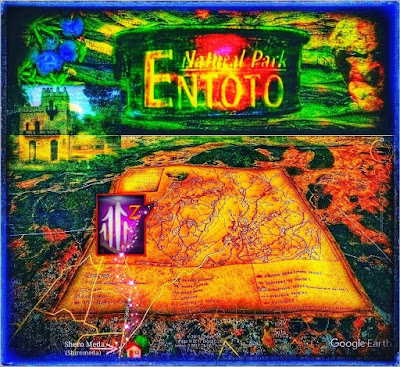
| Bees' Cliff 14 assists by the comprehensive map loop surrounding points 36 and 41-42 Activities and Recreation |
Overwhelming in the impressions of accommodations, Entoto Park's (Z) entertaining activities are extensive within art and culture facilities. In many respects, Entoto Park (Z) offers a wide range of activities for all tastes and interests, where the relaxing activities within the Park meet the family's need for dramatic adventure. Yet, even more, this Park is a serene and golden gateway, intriguing and alluring, stimulating exploration of the Ethiopian Highlands' still-unknown phenomenon in its elusive and majestic wilderness.
A Park On World's Elevated Pillars' Mystique
Here, the mountain's true drama fulfils the essential purpose of creating an eager will for contact with the deep mystique of Nature. Thus, this magnificent view of Entoto's mountain massif's original Nature, allures with its proximity to the secrets of Nature's phenomenon, delivering this unique opportunity to explore. This irresistible academy of the evolutionary past is thanks to the Park's grand facilities, where the critical and forgotten legacy of humankind's fundamental mechanisms is well accommodated alongside these cosy, family-friendly restaurants, activities and amusements.
A Country of Grand Highland's Adventure
Ethiopia's Unique Highland Landscape & Climate
Regarding Ethiopia's unique seasonal climate, with months of heavy downpours across the country's rugged topography, followed by months of blistering sunshine, difficulties naturally arise for the survival of planted saplings. The long prehistoric Nature's evolutionary ooptimizedooptimizedin sheer strength and water infiltration to the ground found in the original native vegetation is thus often impossible to recreate with a simple planting of fragile young seedlings. Consequently, it is usually associated with incredible frustration to reproduce the natural health of ancient Nature and restore healthy landscape biotopes by replanting young native plants on exposed, eroded mountain slopes and devastated high plateaus. Therefore, Ethiopia's neglected indigenous Nature demands knowledge and work before any sign of evident healing of the country's Nature and freshwater conservation.

Requirements: Water and Soil Protections
Thus, it is impossible to recreate a stable, healthy ecosystem by replanting a few native trees on a devastated plateau; instead, these young plants, planted sporadically on the table, will require tender care, irrigation, protection from grazing animals, and shade from the blistering seasonal sun. Furthermore, on the slopes, these young plants most often need some temporary stabilizer of the ground and protection in something that mimics the wind and sun-protective effect of many mother trees. In addition, sporadically placed young plants can only offer a very rudimentary and weak protective network against erosion; instead, there is the obvious risk that these young plants will, in all probability, soon perish in the struggle against great forces.
Thus, it is impossible to recreate a stable, healthy ecosystem by replanting a few native trees on a devastated plateau; instead, these young plants, planted sporadically on the table, will require tender care, irrigation, protection from grazing animals, and shade from the blistering seasonal sun. Furthermore, on the slopes, these young plants most often need some temporary stabilizer of the ground and protection in something that mimics the wind and sun-protective effect of many mother trees. In addition, sporadically placed young plants can only offer a very rudimentary and weak protective network against erosion; instead, there is the obvious risk that these young plants will, in all probability, soon perish in the struggle against great forces.
Humankind's Sciences in Synergy with
Creation of Nature's Foundation
Concerning the enigmatic loss of knowledge from antiquity, it has often surprised today's observers with its historically proven, colossal early insight into high technology and durable concrete. Despite this civilization's advanced knowledge, technology was lost or forbidden and disappeared during the Dark Ages, the early Middle Ages, characterized by the belief in supernatural beings and demonic possession, which plagued humanity for centuries until the end of the Inquisition's compulsive inclination for bestial persecution. However, before the decline in these Dark Ages, civilization proved capable of high technology, which dominated the culture through advanced sciences, engineering, and architecture, whose creations still adorn today's architecture.
Sciences and Technology of the Ancient Civilization
Hence, it follows the natural assumption that on several occasions, the people of highly developed ancient societies have observed the peculiarly amplifying confinement of fossilized organisms in petrified strata and ammonite concretions. Due to this background, within an exceptionally gifted civilization, there is a presumption that they acutely analyzed and copied this reinforcing phenomenon by applying this to the material of their civilization's buildings. This so-called Roman concrete can thus have undergone a development process where they discovered through successes and failures that incorporated specific reinforcing science, hidden within certain fossilized minerals. Therefore, in antiquity, civilizations succeeded in advancing their concrete into a unique material with a crucial ability to self-repair properties over time, which even today remain superior in long-term durability.

The Lost Secrets of Antiquity
The Environment and Humankind's FutureWith the Lost Knowledge from Antiquity
Concerning the enigmatic loss of knowledge from antiquity, it has often surprised today's observers with its historically proven, colossal early insight into high technology and durable concrete. Despite this civilization's advanced knowledge, technology was lost or forbidden and disappeared during the Dark Ages, the early Middle Ages, characterized by the belief in supernatural beings and demonic possession, which plagued humanity for centuries until the end of the Inquisition's compulsive inclination for bestial persecution. However, before the decline in these Dark Ages, civilization proved capable of high technology, which dominated the culture through advanced sciences, engineering, and architecture, whose creations still adorn today's architecture.
Sciences and Technology of the Ancient Civilization
Hence, it follows the natural assumption that on several occasions, the people of highly developed ancient societies have observed the peculiarly amplifying confinement of fossilized organisms in petrified strata and ammonite concretions. Due to this background, within an exceptionally gifted civilization, there is a presumption that they acutely analyzed and copied this reinforcing phenomenon by applying this to the material of their civilization's buildings. This so-called Roman concrete can thus have undergone a development process where they discovered through successes and failures that incorporated specific reinforcing science, hidden within certain fossilized minerals. Therefore, in antiquity, civilizations succeeded in advancing their concrete into a unique material with a crucial ability to self-repair properties over time, which even today remain superior in long-term durability.
|
| The Lost Secrets of Antiquity |
The Environment and Humankind's Future
With the Lost Knowledge from Antiquity
Although this Italian ruin remains a decaying concrete ruin today, the renovation of this mountain fortress point (38) within the loop (B), as shown on the map above, can lay an excellent foundation for a historical discovery of the lost recipe for Roman concrete. Although this historical concrete's millennia-old secrets remain a crucial focus of international laboratories, its deepest secrets may persist. This potential rediscovery of ancient concrete, a lost high technology and historical treasure from antiquity, would offer a scientific study of Roman technology within an educational project.
Although this Italian ruin remains a decaying concrete ruin today, the renovation of this mountain fortress point (38) within the loop (B), as shown on the map above, can lay an excellent foundation for a historical discovery of the lost recipe for Roman concrete. Although this historical concrete's millennia-old secrets remain a crucial focus of international laboratories, its deepest secrets may persist. This potential rediscovery of ancient concrete, a lost high technology and historical treasure from antiquity, would offer a scientific study of Roman technology within an educational project.
The Humankind and Nature within
The World of Reality
Without a doubt, a healthy relationship is essential for every human being, grounded in the laws of Nature and their identity as a member of humankind. With this rule of a deeply interconnected duality of the human identity within the World, biology and psychology reveal their overwhelming influence on humans. Since the natural sciences of biology and psychology regarding humans often appear to be the fundamental core of human Nature, their impact on human health and well-being is particularly evident. However, a development from antiquity of the insidious hierarchical governing terror of the past caused severe scares among many nations, inflicting humiliation in severe famine, thus damaging the population's most critical needs for safe stimulus in daily life and duties.

The Idea of the connection between human behaviourand its genetic heritage is a complicated subject andconstitutes a central core of research on the humanspecies and its civilizaticivilizationst the ages.
A Foundation on Scientific Giants It seems obvious to reconcile Sigmund Freud's description of the human psyche with Charles Darwin's legendary explanation of the origin of species, albeit harsh for many to treat the human species among others and to analyze humankind on this scientific basis. Undeniably, there is a will in human culture to rise above Nature and instead emphasize humanity's elevated origin.
DNA and Psychology UnitedThe unification of the behaviour and biology within the human species is thus a complex problem to summarize. Consequently, great attention is crucial here to ensure careful observation, as the subject is complex and intricate. Therefore, it appears to be a noble opportunity for the individual to become a source of well-being.
___________________________________________________________________________________
Without a doubt, a healthy relationship is essential for every human being, grounded in the laws of Nature and their identity as a member of humankind. With this rule of a deeply interconnected duality of the human identity within the World, biology and psychology reveal their overwhelming influence on humans. Since the natural sciences of biology and psychology regarding humans often appear to be the fundamental core of human Nature, their impact on human health and well-being is particularly evident. However, a development from antiquity of the insidious hierarchical governing terror of the past caused severe scares among many nations, inflicting humiliation in severe famine, thus damaging the population's most critical needs for safe stimulus in daily life and duties.
 |
The Idea of the connection between human behaviour and its genetic heritage is a complicated subject and constitutes a central core of research on the human species and its civilizaticivilizationst the ages. |
A Foundation on Scientific Giants
It seems obvious to reconcile Sigmund Freud's description of the human psyche with Charles Darwin's legendary explanation of the origin of species, albeit harsh for many to treat the human species among others and to analyze humankind on this scientific basis. Undeniably, there is a will in human culture to rise above Nature and instead emphasize humanity's elevated origin.
DNA and Psychology United
The unification of the behaviour and biology within the human species is thus a complex problem to summarize. Consequently, great attention is crucial here to ensure careful observation, as the subject is complex and intricate. Therefore, it appears to be a noble opportunity for the individual to become a source of well-being.
___________________________________________________________________________________
International Retrospective
 |
| Tasmanian tiger, Tasmanian wolf (Thylacine) |
Introducing plants that can harm a country's unique environment may seem reckless. A saviour from imminent disaster may prevail the eucalyptus tree in Ethiopia, since it cannot self-propagate in Ethiopian soil. However, the country most affected by the introduction of foreign wildlife is perhaps Australia's civilization.
Huge Capital Losses - Wild Foreign Animals
This Western culture succeeded by being naive and shortsighted during its short time in Australia. The introduction of foreign animals caused severe trouble across many fields and consequences for precarious sections of Australian society, while posing even greater threats to the survival of the country's original wildlife.
This Western culture succeeded by being naive and shortsighted during its short time in Australia. The introduction of foreign animals caused severe trouble across many fields and consequences for precarious sections of Australian society, while posing even greater threats to the survival of the country's original wildlife.
The Indicated Background to the Loss of the Tasmanian Tiger ( Thylacine).
Perhaps one of the worst offences and acts of insanity was the official extinction of the Tasmanian tiger or Tasmanian wolf (Thylacine). This unique animal was officially eradicated from Tasmania during the first half of the 20th century and had previously faced the same fate on the Australian mainland, with the help of Aboriginal Australians, probably through unintentional actions, but nevertheless due to the consequences of the introduction of wild dogs (dingo).
Perhaps one of the worst offences and acts of insanity was the official extinction of the Tasmanian tiger or Tasmanian wolf (Thylacine). This unique animal was officially eradicated from Tasmania during the first half of the 20th century and had previously faced the same fate on the Australian mainland, with the help of Aboriginal Australians, probably through unintentional actions, but nevertheless due to the consequences of the introduction of wild dogs (dingo).
Many nature enthusiasts wonder why this very athletic and beautiful predator could not survive the onslaught of humans and dingoes. Probably the most prudent answer to this obvious question is that there wasn't enough time and that the required genetic evolutionary changes in the marsupial Thylacine's DNA were too radical. In short, explained, it wasn't enough time for this solitary or pair living marsupial animal to evolve into a formidable close combat fighter in its lone struggle against the combined power of man and its pack-hunting canine predators. The northern-hemisphere predator, Wolverine, or the southern-hemisphere predator, Honey Badger, certainly appears to have an ecological pattern similar to that of the Thylacine. However, the habitats of the Honeybadger and Wolverine have a very long prehistory and have evolved to defend against many herd-hunting dogs and their human companions.
Therefore, unlike the Thylacine, the Wolverine and the Honey badger have had aeons of evolutionary development, with a sharply tempered backbone, in their battle against pack-hunting dogs, wolves and humans. Due to this genetic development through combat with humans, domestic dogs, and wild canines, the wolverine and honey badger have acquired small, consistent, genetically enhanced survival traits and behaviorally controlled fighting traits. Hence, compared to the Australian Tasman tiger marsupial (Thylacine), the mustelids Wolverine and Honey badger were early in prehistory hardened by evolution into the required DNA development of astonishing abilities to climb insurmountable vertical obstacles, together with an incredible ability to use their legendary strength in defence against the aggressions of a multitude of predators. Thanks to their ancient heritage of massive athletic stamina, these impressive animals have often fended off incomprehensibly complex attacks from overwhelming predatory onslaughts since dawn.
However, these genetically evolving countermeasures usually require a very long time to develop, and the concerned mammals or marsupials are not prone to sudden or debilitating setbacks in the power struggle with an overwhelming counterpart. The sudden encounter with humans, their hunting dogs, and wild canines was likely overwhelming for the genetically unprepared marsupial, the Thylacine. The time was insufficient for Thylacine to develop genetic sequences against the new and unexpected threats, which demanded too many changes to its DNA, behaviour, and strategies. However, it is neither without doubt nor utterly confident that the marsupial Thylacine is entirely extinct. Some areas in Tasmania are relatively inaccessible and mostly lack pack-hunting canines and human presence, so there may still be a few unknown, elusive marsupials. Also, several eyewitnesses claim to have witnessed this animal, even on the Australian mainland.
Research Regarding the Resurrection of Extinct Species.
Research Regarding the Resurrection of Extinct Species.
There is an opportunity to exchange knowledge between Australia and Ethiopia, where plants and animals could require protected areas in previously devastated habitats. This offers a unique opportunity for exchange between countries' expertise and unique habitats, including the possible reintroduction of extinct or vulnerable species. These previous mistakes would serve as a foundation for scientific development and a great asset, increasing knowledge in the exciting analysis of the natural sciences.
Furthermore, tissues from this and other lost animals remain in laboratories, so it may be possible to resurrect them and reintroduce them to their original habitats.
Furthermore, tissues from this and other lost animals remain in laboratories, so it may be possible to resurrect them and reintroduce them to their original habitats.
Erosion Prevention Ideas: https://www.pinterest.com/entoto0351/_saved/
Entoto Park (Inquiries):
https://globalvoices.org/2019/08/30/mass-tree-planting-in-ethiopia-broke-world-records-but-its-impact-will-take-time/
_______________________________________________________________________________
 |
| Handbook |
Identification, Propagation and
Management for 17 Agroclimatic Zones
Azene Bekele-Tesemma
Edited byBo Tengnäs, Ensermu Kelbesa, Sebsibe Demissew and Patrick Maundu
The contents of this handbook may be reproduced without special permission. However, acknowledgement of the source is requested. The photographers and artists concerned must be contacted for the reproduction of illustrations. The views expressed in this publication are those of the authors and do not necessarily reflect the views of World Agroforestry Centre.
___________________________________________________________________________________
Edited by
Bo Tengnäs, Ensermu Kelbesa, Sebsibe Demissew and Patrick Maundu
The contents of this handbook may be reproduced without special permission. However, acknowledgement of the source is requested. The photographers and artists concerned must be contacted for the reproduction of illustrations. The views expressed in this publication are those of the authors and do not necessarily reflect the views of World Agroforestry Centre.
___________________________________________________________________________________

Ethiopian Heritage Trust
Donate



Comments
Post a Comment